
Temperance # 14

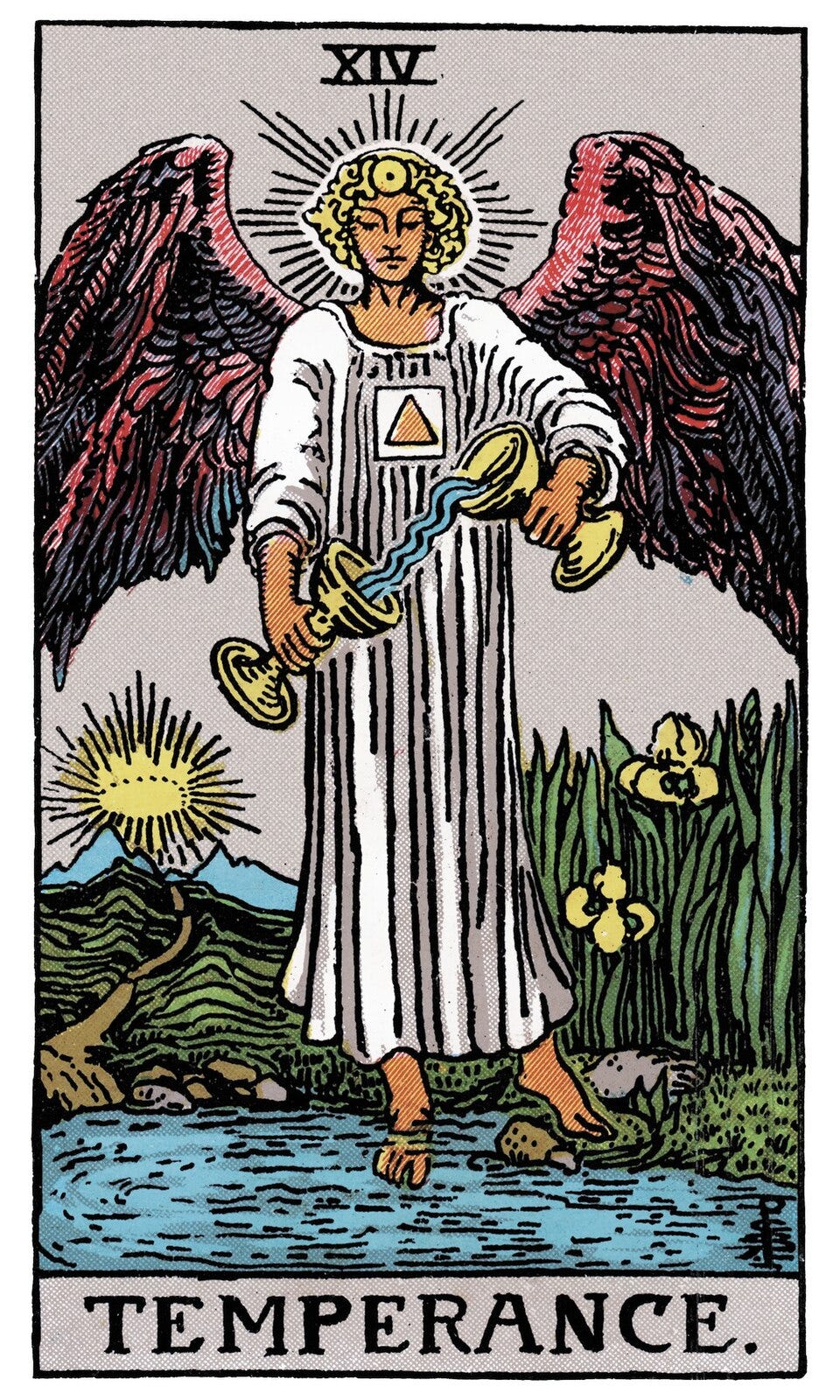
Temperance is a card of healing. After the swing of Death’s scythe has left us a pile of limbs upon the ground, what more can we ask for than a bit of grace, some peace, and some healing?
I struggled to write about her. I tried a draft about the Guardian Angel, but it kept drifting toward Lady Fortune and her gentle nudges. I tried a draft about the Alchemist — that mythical figure who sits in a cave mixing potions in his quest for the prima materia — but that too missed the core essence of what Temperance is.
Then I realized I had already written this piece. And so, without further ado, I present an excerpt from the soon-to-be-published Health as Wholeness (title pending), a book I have written with my mother, Dr. Elizabeth Yurth:
What does it mean to be healthy?
Amidst all the chaos of the medical world, it is a question we rarely reflect upon. The answer seems obvious — but why, then, is it so difficult to put into words?
For most of us, health is simply a feeling. I think many of us would agree that in the goal of recognizing health, it could be summed up in the phrase, “you know it when you’ve got it.”
Yet, beyond the seeming obviousness of feeling healthy, the language we use to describe it proves that the issue is far more convoluted than it might seem at first glance. Sometimes we feel healthier. When feeling sick, the malady can range anywhere from feeling “just a bit off” to being feverish and bedridden. Perhaps, then, health is simply the absence of sickness. But should we describe a tweaked hamstring as being sick? Only if we wish to be misunderstood — yet neither would it be quite right to call it healthy.
Beyond that, health seems such a fickle thing. We might start the day feeling spry and wonderful, only to feel a headache coming on by day’s end. If that headache comes from drinking no water, we’d call ourselves dehydrated, not unhealthy. What if it’s a migraine brought on by the stress of the day? A head cold? Or, God forbid, something worse? Where is the line drawn? At what point does one lose that seemingly ineffable, yet self-evident sense of health? A stuffy nose? A toothache? A hangnail?
So I ask you again: what does it mean to be healthy?
I turn our attention to the word’s origin.
Health derives from the Old English word hælþ — a word that originally meant “wholeness.”
Is that not our answer?
In moments of health, we perceive our bodies and minds as being wholly one. Your failure to notice the part of your head where a headache occurs, or the sensitive lining of your eye that grows so painful with conjunctivitis — that unawareness is health. Our healthiest days are those in which we never once noticed something separate from what we consider our healthy selves. No brain fog, no scabs, no stomach pains, no aches — no separate thing reminding us of the amalgamative quality of our bodies and minds.
Temperance heals. It does so not through some effort of pure will, but through a kind of miraculous process — one by which bones are made whole again, by which a world shattered by grief one day offers you enough grace that you can get out of bed in the morning.
It is only by cutting things into pieces that being made whole becomes possible. Temperance knows this. It is why she can follow Death without flinching.
I had not realized, until now, that the book my mother and I wrote is a book of Temperance. But in my study of temperance I realized that it is our hope that by laying out the remains of the medical world — sharing what she has discovered over thirty-five years of practice, and what she found through her own journey of grief, sickness, and healing — we might invoke the Angel of Temperance. And through that miracle by which bones are made whole, others might find some healing too.